
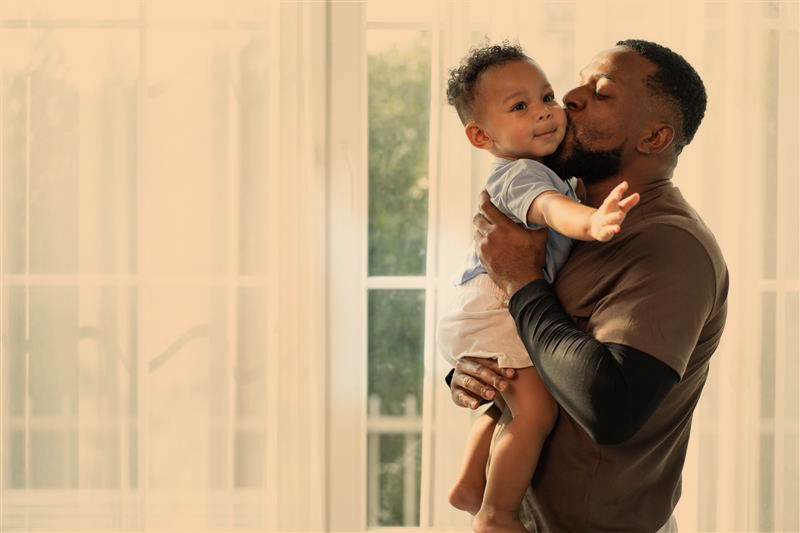
Why the way we work within the Family Justice System Matters for Men and their children.
By Alison Bushell, Founder and Lead Consultant, Child and Family Solutions ltd.
On 19 November, International Men’s Day invites us to support men and boys and to reflect on their health, relationships and contribution to family and community life.internationalmensday.info+1
For those of us working in family law and family justice, this isn’t an abstract theme. Every day we meet men whose identities as fathers are under intense pressure: men in the middle of separation, facing allegations, some of which may be false or malicious, struggling with child arrangements, or shut out of their children’s lives altogether.
Many are doing this while trying to live up to powerful ideas of what it means to be “a strong man” – stoic, self-reliant, unemotional. Take into consideration, then, the new “crisis” of the “toxic masculinity” label and the moral panic that the media feeds from that label and it’s not hard to see why so many men are really struggling.
This International Men’s Day is an opportunity to ask some hard questions:
- How does separation, conflict and litigation affect men’s mental health?
- What role do prevalent ideas about masculinity play?
- What messages are we giving boys about themselves from the education system?
- And crucially – what can family lawyers, judges, and other professionals practically do to reduce risk and support safe, child-focused relationships?
Men, mental health and suicide in the UK
Suicide remains one of the starkest indicators of male distress.
- In 2024, 6,190 suicides were registered in England and Wales – an age-standardised rate of 11.4 deaths per 100,000 people.Office for National Statistics
- The male suicide rate was 17.6 deaths per 100,000, compared with 5.7 per 100,000 for females – roughly a three-to-one ratio.Office for National Statistics+1
- Men in mid-life remain at particularly high risk: in 2024, the highest rate was among men aged 50–54 (27.5 deaths per 100,000).Office for National Statistics+1
- Samaritans’ analysis notes that men account for around three-quarters of registered suicide deaths across the UK and Ireland.Samaritans+1
Behind each statistic is a story – and relationship breakdown especially when accompanied by separation from children is a common feature in many of those stories.
A recent systematic review of over 100 million men found that relationship breakdown is a universal risk factor for suicidal thoughts, attempts and deaths.
American Institute for Boys and Men+1
A separate meta-analysis suggests that separated men are nearly five times more likely to die by suicide than married men, with divorced men almost three times more likely.
So, when we talk about men in the family courts, we are not just talking about legal rights and responsibilities, or parenting time.
We are often working in a space where suicide risk is structurally higher.
Masculinity, fatherhood and help, including therapy.
The ONS and Samaritans have repeatedly highlighted that men’s higher suicide risk is linked to a mix of factors: economic pressure, social isolation, and beliefs about what it means to be a man.
Office for National Statistics+2 Samaritans+2
Common themes we hear from fathers at Child and Family Solutions include:
- “I have to hold it together – I can’t afford to fall apart.”
- “If I say I’m struggling, it’ll be used against me, they’ll say I can’t cope”
- “I’m already being painted as the problem; I can’t show weakness.”
- “I’m already accused of being angry by my ex so I can’t express that with my solicitor or in court, even though I feel angry at the system, at the delays and at how I am being marginalised.”
- “I don’t want to be a contact dad, I was a fully involved dad”
- “It feels like a bereavement not to see my kids”
These are not irrational fears.
Men from disadvantaged backgrounds, in their 30s, 40s and 50s, are among those at highest risk of suicide, and are often least likely to be engaged with support services.
When separation happens, traditional scripts about masculinity collide with:
- loss of the day-to-day parenting role
- financial strain (child maintenance, rehousing, legal fees)
- fear of losing contact with children
- fear that the children will feel abandoned “ he left us” is sometimes heard from mothers.
- shame about “failed” relationships, this is compounded in some cultures and religions by norms about the sanctity of family life.
Men may present in solicitors’ offices, at MIAMs, in Cafcass interviews or in our assessment interviews appearing rigid, depressed or withdrawn.
Beneath that, there is often grief, humiliation and a visceral fear of losing contact with their children. This can present as anger and exasperation, and we sometimes see this desperation being ‘managed’ by unhealthy coping mechanisms such as substance / alcohol overuse which only serves to compound psychological vulnerabilities.
If those emotions go unrecognised or are misinterpreted purely as “non-compliance” or “control”, by inexperienced or judgemental practitioners, risk can escalate. It is imperative to recognise that when making our assessments and remain open to the possibility that our male clients may also be victims of coercive control or abuse, whether prior to or post separation.
Separation, delays in family proceedings and chronic stress
The family court environment with the cuts to hearing centres and the lengthy delays can exacerbate men’s distress, particularly in long-running, high-conflict cases.
- In July–September 2024, there were 13,649 new private law children applications in England and Wales, involving over 20,000 children, a 2% rise on the same quarter in 2023 .GOV.UK
- The Family Court Annual Report 2024 records 43,315 private law children cases in that reporting year, and 41,020 outstanding cases in July 2024 (down from 46,690 the previous year but still a substantial backlog).
Courts and Tribunals Judiciary+1
- A National Audit Office review found that average case durations have stretched to around 36–41 weeks, with thousands of public and private law cases exceeding two years.
For parents – and especially for fathers who feel proximity to their children slipping away – these timelines can feel unmanageable.
Men describe the process as “being in limbo”, “punishment” or “watching my relationship with my child slowly die”.
We also know many parents are now litigants in person. For men who are sometimes already reluctant to seek emotional support, trying to navigate complex proceedings alone can deepen the sense of failure and isolation. Whilst there are many reliable sources of help for parents who cannot or choose not to pay legal fees, there are also those who are inexperienced, or who hold to a particular agenda that might miss the nuances of a client’s unique circumstances.
Helpful links to reliable McKenzie Friends:
https://familylawassistance.co.uk/mckenzie-friend-the-ultimate-guide/
When fathers lose contact: alienation, rejection and risk
Research consistently shows that most separated fathers remain in touch with their children. Large UK studies have found that around 80–87% of non-resident fathers have some contact, many on a weekly basis
It must be considered however that for fathers who have, prior to separation, seen their children every day, have been part of their lives, celebrated their ‘day at school’ news and their achievements, this still represents a huge loss.
Also, a significant minority do not even have this level of contact:
- An analysis of UK survey data suggests that around 15% of separated fathers have no contact with their children, and that the likelihood of non-contact increases by about 2.5 percentage points for each year since separation.
- LSE Blogs+1
For those fathers – and for the children involved – the psychological impact can be profound and damaging.
The Removal of the Presumption of Parental Involvement: Possible Implications
The Government’s announcement that it intends to remove the statutory presumption of parental involvement post separation could be said to mark a significant conceptual shift in private law.
While the stated aim is to ensure child safety remains paramount—particularly in cases involving domestic abuse—the change may carry unintended consequences for fathers’ mental health and for family court dynamics.
Increased uncertainty and anxiety
For many fathers, the presumption has served as reassurance that their role is recognised and valued. Removing it may heighten fears of losing their children, particularly in the early stages of separation when men are already emotionally and psychologically vulnerable.
Potential for more adversarial litigation, heightening risk to mental health
Without a guiding principle, more cases may begin from a position of dispute. Baseline expectations previously considered settled could become contested again, potentially increasing case durations.
Possible effect on fathers seeking help
Men may become even more reluctant to disclose mental health struggles if they believe this could influence decisions about involvement. This further entrenches the barriers men already face to seeking help.
Inconsistency in practice
Without a presumption, outcomes may vary more from region to region and judge to judge. Perceptions of inconsistency can intensify despair or anger in high-risk fathers.
It is crucial however to avoid catastrophising at what many understandably see as a retrogressive step for shared parenting.
Some hope is already evident by informal discussions already held with members of the judiciary and senior counsel that good sense will prevail and that the Paramountcy Principle will still be the gold standard when decisions are made.
Risks in cases involving allegations
There is an inbuilt danger of ‘over-correction’ and risk averse decision making —where unproven allegations or high conflict alone result in contact restrictions, even where risk is low and relationship loss could be harmful.
At the same time, genuine safeguarding concerns must continue to be treated seriously. There is still, in general, a marked underuse of supervised contact where some risk is alleged or may exist and we are hopeful that this will change.
CFS would like to see a voucher scheme in place as is the case for MIAMS where some contribution to the costs of professional contact is covered.
One possible – but how likely?- positive outcome: more evidence-led decision-making
If implemented well, the change could encourage more nuanced assessments, reduced reliance on formulaic arrangements, and greater emphasis on children’s lived experiences. My fear is however that this would require far better training of social workers and CAFCASS workers in how conflicted and aligned children present during assessment and a greater understanding of how and why this alignment is per se harmful to the child’s emotional development.
With CAFCASS backlogs as they are and have been for some time and Local Authority caseloads as high as they are, is this a realistic aim?
Our main concern: widening the gap between fathers and children- how does delay damage the bond?
If the reform leads to more fathers losing meaningful contact or facing longer periods of suspended involvement, their mental health impact could be substantial—especially given the already elevated suicide risk among separated men.
We have many fathers with whom we are currently working with very young children, and our skilled team who are all trained to some degree in child development are very aware of the devastating impact gaps in contact can have for the attachment relationship. Given the seemingly ever widening gaps between hearings, there can be literally months of no contact at all between a father and his two year old. This can have long term consequences for their relationship.
I can still clearly recall a talk given by the late, highly regarded Family Judge DJ Nicholas Creighton in maybe 2002 to a conference in Westminster -his words have stayed with me to this day. “ when we think of a year as adults, it’s just a year, it flies past…for a small child this can represent half of their life”.
At CFS we keep this in mind when working with families and our therapeutic social work team will do everything to ensure that even if there are short agreed periods of contact for our Dad clients, that these are assessed and the interactions carefully reported on, so as to give the Court proper evidence by which to make decisions.
At Child and Family Solutions, our core work is with families in high-conflict separations, including many where children are resistant or refusing contact with one parent and where there are allegations of parental alienation, coercive control or both.
Family Separation Reform Campaign +1
Our ethos is clear:
- Children generally benefit from a relationship with both parents, where it is safe to do so.
- Shared parenting – in the broad sense of both safe parents remaining involved and responsible – is always associated with better outcomes for children.
- We are particularly alert to gendered assumptions that fathers are less important, and to the under-recognised cohort of male victims of domestic abuse. In our assessments we ask both parents about whether they have experienced abuse. In many if not most of the interviews with fathers, we are the first family law professional who has asked them about this and for some we are the only person they have told.
For some men, being shut out of their children’s lives – whether through justified safeguarding steps or through unjustified obstruction and denigration – can trigger or intensify suicidal thinking.
That risk is especially acute when:
- the father has a history of poor mental health or trauma.
- proceedings are prolonged and adversarial.
- They cannot afford or have exhausted funds to be represented.
- there is a perception or evidence of systemic bias.
- their own support networks are limited.
- they are under considerable financial strain, often still paying a mortgage and now additional housing costs.
None of this means that courts should compromise on child safety, or that allegations against fathers should be minimised.
It does mean that contact, identity and mental health cannot sensibly be separated in how we assess and manage these cases.
What can family law professionals do differently?
Family lawyers, Judges, Magistrates, Cafcass officers and Independent Social Workers are not mental health clinicians. At CFS we are fortunate to have an excellent therapy team from whom we gain valuable insights and who we can consult if we are concerned.
But even so, we are part of the ecosystem that can either increase or reduce risk.
Some practical shifts can make a real difference.
- We need to risk assess in a non gendered and open way early on in our work with a family.
- Routinely ask fathers (and mothers) about their wellbeing in humane, non-clinical language:
“How are you coping with all of this?” “ do you have someone to speak to?” - Be clear that disclosing distress is not a tactical disadvantage and will not automatically be weaponised in proceedings. Being open and honest and expressing authentic emotions is a positive indicator of self awareness.
- Where concerns arise, signpost or refer to appropriate support – GP, IAPT/psychological therapies, local men’s groups, or crisis services such as Samaritans (116 123) or NHS urgent mental health helplines.Samaritans+1
- For victims of domestic abuse refer to those agencies that specifically assist male victims.
- Challenge unhelpful and dangerous gender assumptions.
- Avoid default narratives that minimise fathers’ importance or assume mothers are always primary carers, particularly where the pre-separation pattern of care was more balanced.
- Treat allegations of abuse against men with the same seriousness and curiosity as allegations against women, while maintaining a robust safeguarding lens.
- Reduce unnecessary conflict and delay
- Explore and encourage mediation, parenting coordination, and child-inclusive processes wherever safe and appropriate. These can reduce litigation stress and give children a voice outside the adversarial framework of proceedings. We work with many family solicitors and barristers who ask us to help their clients to avoid court proceedings.
- Provide draft orders and parenting plans that are clear, realistic and future-focused, reducing the need for repeated returns to court.
- Support and recommend to Judges the use of specialist reunification and contact-resistance interventions where a child is rejecting a parent and make a robust analysis of the ascertainable rather than merely the expressed wishes of children caught up in high conflict situations.
- Remain professionally curious at all times.
- Adopt a trauma- and loss-informed perspective
- Recognise that many men in proceedings are managing multiple losses at once – home, role, community, financial stability, and sometimes reputation.
- Read anger, rigidity or apparent indifference as possible signals of anxiety or despair, not just as difficult behaviour.
- Be attentive to sudden changes in presentation – withdrawal, hopeless statements, giving away possessions, or a preoccupation with being “better off out of the way” – and respond proactively.
How we at CFS work with these realities…
Child and Family Solutions was founded to offer independent, therapeutically informed child-focused social work services in high-conflict separations, with a strong emphasis on shared parenting and fairness to both parents.Child and Family Solutions+1
Our work includes:
- Expert assessments (e.g. section 7, parenting capacity, risk and balance-of-harm reports) that explicitly consider the psychological impact of separation on each parent, including men’s mental health.Child and Family Solutions
- Reunification programmes where children are resistant or refusing contact, working step-by-step to rebuild trust after time apart.Child and Family Solutions+1
- Parenting plan mediation and dispute resolution, helping parents reach child-focused agreements without unnecessary court involvement.Child and Family Solutions+1
- Awareness of male victims of domestic abuse, and a commitment to challenge gender bias where it is inconsistent with the evidence.Child and Family Solutions
We do not minimise risk, collude with harmful behaviour, or romanticise shared parenting where it would be unsafe. But we are clear that a system which routinely sidelines one parent – often the father – also risks creating conditions for serious mental health harm, with knock-on effects for children.
International Men’s Day as a call to action
International Men’s Day is sometimes caricatured as a backlash against women’s equality. That is not the vision we work from.
For those of us in family justice, supporting men and boys means:
- taking male distress seriously, including suicidal thinking
- insisting that fathers’ relationships with their children matter, and challenging bias where evidence supports that challenge
- designing processes that reduce unnecessary conflict and delay
- using our professional roles to signpost, to listen, and to humanise a system that can feel dehumanising
The statistics on male suicide and the evidence linking separation and suicide risk are sobering. But they are not inevitable. Every thoughtful conversation with a distressed father, every balanced assessment, every proportionate court order, and every well-supported reunification is a small act of prevention.
This 19th November, perhaps the most meaningful way our sector can mark International Men’s Day is simple:
See men. Hear men. Take their mental health seriously – not in opposition to women’s safety, but alongside it – so that more children can grow up with their fathers alive, involved and well.
If you or a client is struggling….
- Samaritans – call 116 123 free, 24/7, or visit their website for other ways to get support.Samaritans+1
- NHS urgent mental health helplines – available in every area via the NHS website.Office for National Statistics+1
- www.bothparentsmatter.org.uk
REFERENCES (AND FURTHER READING FOR THE PROFESSIONALLY CURIOUS! )
- Office for National Statistics (2025) Suicides in England and Wales: 1981 to 2024. ONS.Office for National Statistics
- Samaritans (2024–25) Latest Suicide Data – England and Wales factsheets. Samaritans.Samaritans+1
- Department of Health & Social Care (2023) Suicide Prevention in England: 5-year cross-sector strategy.GOV.UK
- Ministry of Justice / HMCTS (2024) Family Court Statistics Quarterly, July to September 2024.GOV.UK
- Judiciary of England & Wales (2024) Family Court Annual Report – October 2023 to September 2024.Courts and Tribunals Judiciary+1
- Cafcass (2025) Our data – open public and private law cases.Cafcass
- LSE / Understanding Society (2020) ‘Staying involved? The relationship between pre-separation fathering and contact’.LSE Blogs+1
- Evans, Scourfield & Moore (2016) Gender, Relationship Breakdown and Suicide Risk.Orca
- Barrass, L. (2025) ‘When relationships end, men’s risk of suicidal behaviour’. National Elf Service blog summarising systematic review.National Elf Service+1
- Samaritans (2021) Research Briefing: Gender and Suicide.Samaritans+1
- Child and Family Solutions (2025) About Us and Resources for Parents – ethos, services and shared parenting position statements.Child and Family Solutions+2Child and Family Solutions+2